work1812 (Grimm); oral tradition, ~medieval

Floris van Schooten, A Still-life with Bread, Cheese and a cut Pie (17th Century). Wikimedia Commons
Hänsel und Gretel
The one with the house made of sweets.
To Explore
- What significance did the forest hold for German Romanticism, and how can we read the forest of Hansel and Gretel in that light?
- What can the foods in the tale tell us about the world it came from, and what did they mean to people living in times of scarcity?
- How is the witch represented in folklore, and what is her relationship to the figure of the mother? How does the witch of folklore and fairytales compare to the one imagined during the European witch trials?
Notes
Brothers Grimm
- Jacob and Wilhelm Grimm first published Kinder- und Hausmärchen, the collection that includes Hansel and Gretel, in 1812. Germany wasn't one country yet, just a patchwork of independent states that shared a common heritage, these folktales among it. The Grimms saw that heritage as central to German identity, and part of what the collection did was preserve the oral traditions of these lands before a unified nation existed.
- These tales came out of a long oral tradition. Before most people could read, tales were told at home and by the hearth, often by the women of the family, carrying local lore and moral lessons down the generations.
- The brothers first meant the collection as a scholarly record of folk culture, but later editions were tailored more and more to children, softened and made family-friendly, gradually becoming the bedtime stories we know now. It went on to become one of the most influential works of folklore ever published.
German Romanticism
- German Romanticism celebrated imagination, nature, and tradition, and often turned to folklore as a counterweight to industrialisation. As people moved into cities and factory work, living by the clock instead of the seasons, the Romantics felt the older, land-tied way of life was being lost. So you can see why a collection like Kinder- und Hausmärchen spoke to them - folktales were part of the very heritage modern life seemed to be pushing aside.
The forest
- For the Romantics, the forest carried a lot of symbolic weight. It stood for nature as a powerful force, and for escape from the order and rationality of modern life. We can read Hansel and Gretel's forest in this light. At home, the story feels real and recognisable - we see poverty, hunger, a cruel parent. Once the children are in the forest, they leave ordinary life behind and the world becomes more imaginative and symbolic, where they meet a cannibalistic witches and find a house made of bread.
- There's also the Romantic idea of the sublime, the awe we feel before something in nature so vast and powerful it overwhelms us. The forest in Hansel and Gretel has something of that quality, vast and disorienting, swallowing the children up, indifferent to whether they live or die.
The witch
- The witch is one of the oldest figures in European folklore. She's almost always a woman, usually old, living apart from society, at the edge of the village or deep in the forest. She's seen as dangerous, tied to herbs, charms, and curses, and often a threat to children. The witch in Hansel and Gretel ticks most of these boxes, old, alone in the forest, and hungry for a child to eat.
- She and the stepmother are closely linked. The scholar Maria Tatar sees them as two faces of the same figure. What connects them here is food. The stepmother starves the children and abandons them. The witch appears as her opposite, luring them with a house made of food. But it's a trap, and the witch, who means to eat them, is worse still, and in Tatar's words, "an intensification of the maternal evil at home." It's a common fairytale pattern - the cannibal villain who inverts the mother, starving and threatening to eat the children she should feed.
- Between the fifteenth and eighteenth centuries, tens of thousands of people, mostly women, were tried and executed for witchcraft, much of it in the German-speaking lands. The accused was typically an older woman on the margins, poor, widowed, or alone, often charged with harming children. The witch in Hansel and Gretel, old, alone in the forest, fattening children to eat, fits this same image.
Food and sweets
- We picture the witch's house as made of gingerbread today, but that image only came after the tale was published in the early 1800s. In the original it's made of bread, cake, and sugar, and even that would have been an extraordinary fantasy of abundance. The tale comes from a time when crop failures and famine were a regular part of life, and most people lived on simple food, dark bread and porridge, with anything richer saved for rare occasions.
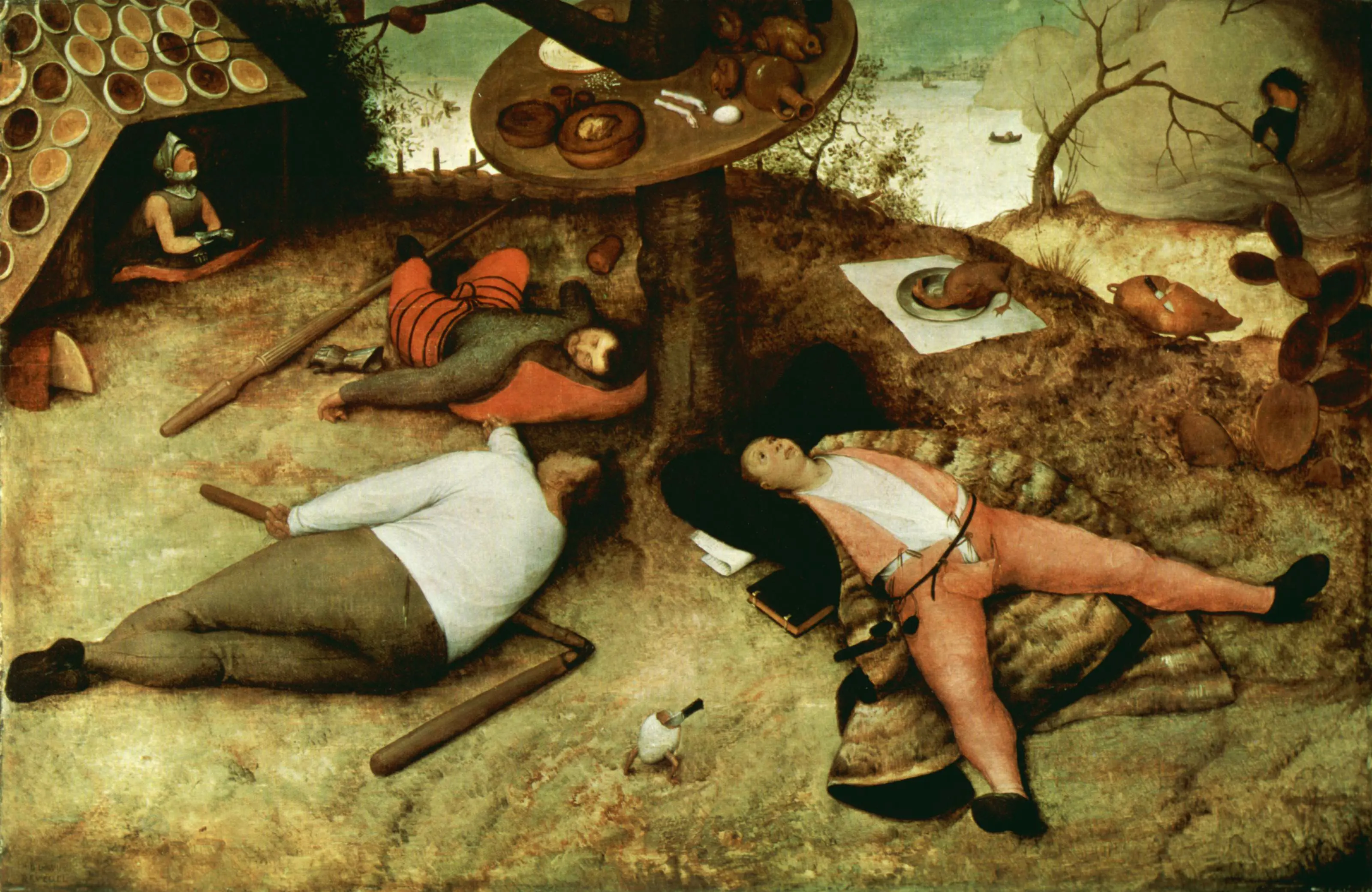
- The witch's house can be read in relation to Schlaraffenland, the "Land of Plenty", a popular early modern fantasy of a place where food was abundant. The idea was widespread across the German-speaking lands, the subject of a 1530 poem by Hans Sachs and depicted in Pieter Bruegel the Elder's painting of 1567. For two starving children, a house of bread and sugar represents the same fantasy of impossible abundance.
- The foods themselves would have felt like luxuries. Cake and pancakes needed butter, eggs, and sometimes sugar, so were festive treats rather than everyday foods. Sugar especially was precious, imported and expensive before industrial production made it cheap.
- German cooking had two main pie-like pastry types - the Fladen, an open tart the poor ate occasionally on feast days, often topped with fruit or vegetables, and the Pastete, an enclosed pie that - when filled with meat or fish - was moreso eaten by the wealthy (both of these could also be called Kuchen).
Images
reference materials
Books
Hänsel und GretelGrimm Brothers, 1812
The hard facts of the Grimms' fairy talesMaria Tatar
The witch: a history of fearRonald Hutton
From the beast to the blondeMaria Warner
Fairy tales and the art of subversionJack Snipes
Beyond bratwurst: a history of food in GermanyUrsula Heinzelmann
Das Buoch von guoter SpiseAnton Birlinger
Films
The witchRobert Eggers, 2015
SuspiriaLuca Guadagnino, 2018
Podcasts
Hansel and GretelMyths and legend
Other
Lebkuchenhaustreats at the German Christmas market
Key figures
Linked nodes

