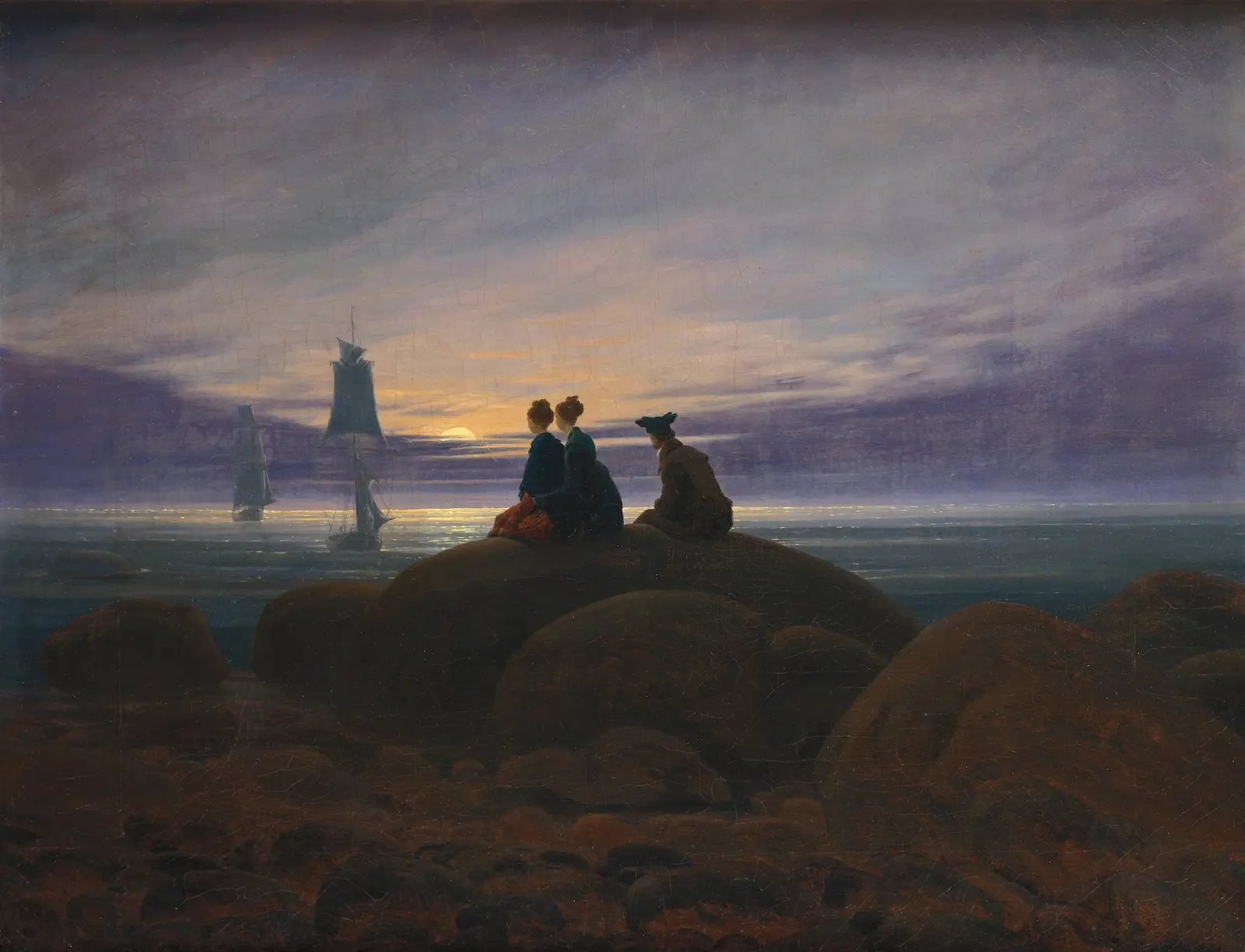
Caspar David Friedrich, Moonrise over the Sea (1822). Wikimedia Commons
German Romanticism
German Romanticism (Deutsche Romantik) was an artistic and intellectual movement that developed from the late 18th to the mid-19th century. It emerged partly in response to Enlightenment rationalism and the growing influence of industrialisation.
The movement placed greater value on emotion, imagination, and the idea of the infinite than on reason and scientific order. Writers such as Novalis, E.T.A Hoffmann, and Ludwig Tieck, along with collectors like the Brothers Grimm, turned to nature, myth, and the medieval past as ways of responding to the growing sense of disconnection brought by modern life.
Core Ideas & Themes
Sehnsucht
The feeling of longing for an undefined, unattainable ideal, which underpins much of Romantic art and thought.
Naturphilosophie
The idea of nature as a living, spiritual whole that reflects the same forces as the human mind.
Volksgeist & myth
The collective spirit of a people as expressed in folklore, language, and myth, representing a return to cultural roots neglected by Enlightenment thought.
Das Unheimliche
The uncanny - the unsettling transformation of the familiar into something alien, tied to the unconscious and the figure of the double.
Waldeinsamkeit
Forest solitude - the feeling of isolation in nature where one’s sense of self fades into the vastness of the surrounding landscape.
The Sublime
Moments in which nature appears so immense or powerful that it overwhelms understanding, combining awe with a sense of unease.

